Current as of: October 20, 2026 - 20:35

Cycling Costa Rica Trip Notes
- Ways to Travel: Classic, Guided Group
- Destination: Costa Rica
- Programmes: Cycling
-
Activity Level:
3 out of 7 - Moderate
- 14 Days: Land Only
- Ages: 16+
- Trip Code: MCR
Trip Overview
Ride among volcanoes, rainforest and coasts on a two-week showreel of Costa Rica’s celebrated landscapes
Embark on a cycling adventure designed to immerse you in the unique natural beauty and diversity of Costa Rica. Led by an expert cycling guide who knows all the best viewpoints, you’ll discover volcanoes, rainforest and two very different coasts. Off the bike, you’ll search Tortuguero’s canals for wildlife, walk historic lava fields, unwind in hot springs, sail on a catamaran at sunset and cook traditional dishes with a local chef. It’s an active journey that brings Costa Rica’s landscapes, wildlife and culture thrillingly close.
Is This Trip for You?
This trip is classified Activity Level 3 (Moderate). For more information on our trip gradings, visit our Activity Level Guidelines page. If you have any queries about the difficulty of the trip, please contact us.
- Average daily distance: 28mi (45km)
- Number of cycling days: 11
- Total distance: 309mi (497km)
- Terrain: 76% paved, 24% gravel (mixed)
Terrain & route: We mainly use rural gravel paths and quiet roads where possible. Occasionally, we cross or ride along some busier roads. This first ride is intentionally kept relatively short and easy, providing the perfect introduction to both the terrain and your bicycle, allowing time to adjust and settle into the rhythm of the journey. The route is varied throughout, with rides passing volcanoes, lakes, rainforest, farmland, and coastal landscapes. Distances range from 21mi (34km) to 41mi (66km), with a mixture of rolling terrain, longer climbs and rewarding descents. Some sections are remote and adventurous, where gravel roads add to the challenge and sense of exploration.
Vehicle support: A support vehicle accompanies the group throughout the trip, carrying luggage, water, snacks, and spare equipment.
Swimming: There are plenty of swimming opportunities on this adventure. However, the sea has very strong rip currents in Tortuguero and is not suitable for swimming from the beach.
Transfers: Timings stated in the itinerary are estimates. Transfer times may take longer when the roads are in a poor condition.
Water safety: This trip includes time by a lake, river or sea, where there may be opportunities to swim. You should always seek local advice before deciding whether to swim. Open-water or wild swim spots should be treated with extreme caution. Information on how to keep yourself safe while swimming is shown here.
Cycling safety: Your safety is our number one priority. The Exodus Safe Cycling Guide explains how we will keep you safe throughout your trip. We also ask for your support by following the guidance and recommendations outlined in the guide.
Group
Our local team of leaders has proved very popular with their incredible knowledge, passion and hospitality adding greatly to the experience. There is no better way to experience Costa Rican culture than letting a local guide show you around their country. Depending on group size, there may be one or two cycling leaders.
Adult min age: 16
Min group size: 6
Max group size: 16
Itinerary

Land Only
- Start City: San José
- End City: San José
Land Only Itinerary
Adventure begins in San José
Begin your adventure in San José, Costa Rica’s capital, which was founded during the first half of the 18th century and sits in the Central Valley.
Around 6pm, say hola to your tour leader and fellow travellers, when we gather as a group for the first time to get to know each other and learn more about the adventures ahead.
Your tour leader then ensures a big Costa Rican welcome by arranging a group dinner.
Want more time in San José? Secure pre-tour hotel nights through your sales representative.
Accommodation: Delta Hotels by Marriott San Jose Aurola (or similar)
Pedal through the scenic Orosí Valley

A transfer (1hr 10min) from San José takes us to the town of Cartago, our start point for today’s cycling in the scenic Orosí Valley, one of the most fertile and historically rich regions in Costa Rica.
After bike fitting and adjustments, we set off. Our first ride is relatively relaxed, a chance to get comfortable in the saddle while our tour leader introduces the riding style, road conditions and rhythm of the days ahead.
Leaving Cartago behind, we cycle through rural communities and green hillsides, passing farmland and forested slopes as we make our way towards the Orosí Valley. The route takes us through the highlands before descending towards the valley, with views of the surrounding mountains.
We continue through Orosí, home to one of Costa Rica’s few surviving colonial churches, before finishing our ride at the historic church ruins of Ujarrás. From here, we transfer to our hotel for the night.
Terrain: 60% paved, 40% gravel (mixed)
Accommodation: Rinconcito Verde Hotel (or similar)
Descend the famous Route Between Volcanoes
Transfer (one hour) into the Central Highlands, climbing through farmland where potatoes, onions and carrots grow in mineral-rich volcanic soil.
At Irazú Volcano National Park, we visit Irazú itself, Costa Rica’s highest volcano at 11,260ft (3,432m). When cloud conditions cooperate, the elevated viewpoints can reveal part of the Caribbean coast and neighbouring Turrialba Volcano.
After exploring the national park, we transfer a short distance and begin the Route Between Volcanoes, a long, largely downhill ride linking Irazú and Turrialba. Our tour leader sets a controlled pace as we lose more than 9,800ft (3,000m) in elevation, moving from exposed volcanic terrain into farmland and greener mountain country.
We finish the ride in Aquiares and take a 30-minute transfer to the hotel in Turri, an agricultural town in a fertile valley surrounded by mountains and volcanoes.
Terrain: 49% paved, 51% gravel (mixed)
Accommodation: Villa Florencia or Guayabo Lodge (or similar)
Ride into the Caribbean lowlands • Cruise to Tortuguero
Leaving Turrialba by vehicle (1hr 30min), we descend from the mountains towards the warmer Caribbean plains, watching the vegetation change as we lose altitude.
Begin cycling from the lively agricultural town of Siquirres, following flat roads through banana-growing country, cattle farms and small settlements. The easier terrain leaves us free to watch for lowland birdlife, with our tour leader helping us identify the species commonly seen along the route.
At Caño Blanco, swap bikes for a boat and continue along rivers and narrow forest waterways to Tortuguero. The community has no connecting road, so arriving by water is part of understanding how geography shapes daily life here.
After reaching our destination, we visit Tortuguero village, where sandy paths, wooden homes and Caribbean influences distinguish the settlement from those encountered earlier in the trip.
Terrain: 80% paved, 20% gravel (mixed)
Accommodation: Laguna Lodge (or similar)
Cruise the wildlife canals of Tortuguero • Relax in our jungle lodge

Enter Tortuguero National Park by boat before breakfast, when cooler conditions often bring greater animal activity along the waterways.
Our tour leader is joined by a keen-eyed boat captain who reads the forest margins for movement that is easily missed. Together, they help us look for monkeys, caimans, iguanas, butterflies and some of the many bird species associated with this wetland ecosystem. Tortuguero also protects one of the Western Hemisphere’s most important green turtle nesting beaches, though sightings depend on the season and cannot be guaranteed.
Returning to our accommodation, we walk the lodge trails, where our guide can interpret the plants and smaller wildlife around us.
The rest of the day is free for you to stroll through the gardens and relax by the pool, while meals are served at the lodge.
Accommodation: Laguna Lodge (or similar)
Cycle to La Fortuna • Unwind in Arenal’s hot springs

Bid farewell to our remote retreat and leave Tortuguero, making one final journey through the forest waterways before reaching the mainland.
When water levels permit, we disembark at La Pavona and cycle towards Guápiles. The mostly flat route passes settlements, banana plantations and lowland farms, providing a gentle return to the bikes after our time in Tortuguero. If water conditions prevent us from using La Pavona, the local team adapts the cycling route and provides an alternative ride through the plains.
From Guápiles, we transfer (2hr 20min) through the agricultural plains of Sarapiquí towards our accommodation in La Fortuna, near Arenal Volcano.
In the afternoon, we visit Ecotermales, where naturally heated water of volcanic origin feeds a series of pools. It is a welcome chance to loosen cycling legs, followed by dinner at the hot springs.
Terrain: 77% paved, 23% gravel (mixed)
Accommodation: Arenal Country Inn (or similar)
Ride beneath Arenal and cross old lava • Cook Costa Rican dishes with a local chef

Cycle from La Fortuna onto quieter rural roads, passing grazing land, small farms, rivers and patches of forest. Arenal Volcano appears at intervals as we tackle the gently rising and falling terrain.
Our tour leader manages the pace and selects suitable stops, leaving us enough energy for the afternoon’s walk at Arenal 1968. Here, trails cross regenerating forest and lava deposits from the volcano’s major eruption in 1968.
Later, we join a local cook for a hands-on cooking experience. After learning about the produce grown in the garden, we help prepare Costa Rican dishes, which may include handmade tortillas and food cooked over a wood fire. We then sit down together to eat what we have made, enjoying volcano views as we dine.
Terrain: 100% paved
Accommodation: Arenal Country Inn (or similar)
Follow the shores of Lake Arenal
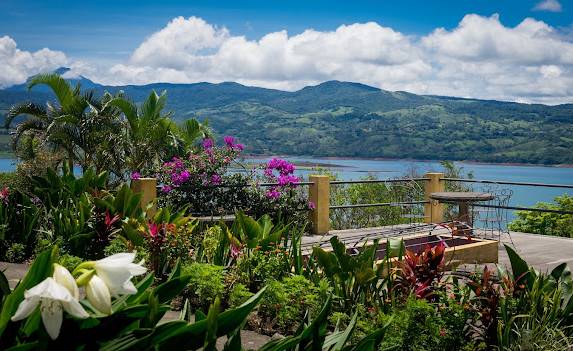
A 30-minute transfer takes us towards Lake Arenal, where we begin our ride near Arenal 1968, with the impressive landscapes surrounding Arenal Volcano setting the scene for the day ahead.
We follow the road towards Tilarán, cycling through the beautiful countryside that surrounds Costa Rica’s largest reservoir. The route rises and falls through a landscape of lush farmland and small rural communities, with sweeping views across the lake and towards the surrounding mountains. Weather permitting, we can also enjoy views of Arenal Volcano, one of Costa Rica’s most iconic natural landmarks.
Today’s terrain brings a series of climbs and rewarding descents, and our tour leader helps us find a comfortable rhythm as we make our way around the lake. As we approach the Tilarán side, the landscape becomes broader and more open, offering a striking contrast to the tropical forests around La Fortuna.
We finish our ride near Café Macadamia, bringing a scenic and rewarding day in the saddle to a close, before a short transfer to our hotel. The remainder of the day is free to relax.
Terrain: 100% paved (mixed)
Accommodation: Lake Arenal Hotel, Brewery & Farm (or similar)
Cross the dry-forest country of Guanacaste
We leave the Lake Arenal area this morning, cycling directly from our hotel through rolling countryside towards Tierras Morenas and the Tenorio Volcano area.
As we ride, the lush scenery around Lake Arenal gradually gives way to the warmer, more open landscapes of Guanacaste. Entering the tropical dry-forest zone, we pass cattle country, agricultural land and scattered woodland, with less shade than on previous rides.
After the rolling terrain of the first section, we enjoy a long descent towards the plains below, with expansive views of the surrounding countryside. Our ride finishes at the Upala-Cañas junction, where we transfer by vehicle to Guayabo de Bagaces (approximately 40 minutes).
Terrain: 68% paved, 32% gravel (mixed)
Accommodation: Cabinas Ledezma (or similar)
Cycle to Liberia • To the Pacific coast
We ride directly from our accommodation in Guayabo de Bagaces, setting off through the open landscapes of Guanacaste towards Liberia.
The scenery impresses from the moment we start. This is ranching country, and the route passes grazing fields, farms and dry-forest vegetation, with views of three volcanoes in a single day: Miravalles, Tenorio and Rincón de la Vieja. Few rides in Costa Rica offer such a striking combination of volcanic scenery.
Our route combines paved roads with gravel and white-stone sections as we climb through the foothills before enjoying a rewarding descent towards a natural canyon near Rincón de la Vieja.
We finish our ride at Liberia Central Park and from Liberia transfer (45 minutes) to the Gulf of Papagayo on the Pacific coast.
The evening is free to relax and enjoy the quieter pace of our beachside accommodation.
Terrain: 45% paved, 55% gravel (mixed)
Accommodation: Hotel Villas Sol (or similar)
Ride the Pacific backroads • To Playa Brasilito and Portrero
Starting directly from our hotel in Playa Hermosa, we set off on a ride through Costa Rica’s northwest Pacific coast.
Following the paved roads of the Congo Trail, we cycle through countryside, tropical dry forest and small rural communities. A succession of gradual climbs and flowing descents takes us through the coastal hills, with the changing scenery providing a backdrop to our final miles on the bike.
As we make our way towards Brasilito, the landscape becomes increasingly coastal, bringing us closer to the beaches and laid-back atmosphere that characterise this corner of Guanacaste.
We finish our ride in Brasilito and continue to our accommodation in the Potrero or Brasilito area, where the remainder of the day is free to relax and enjoy the Pacific coast.
Terrain: 100% paved
Accommodation: Parti Gras Hotel or Conchal Hotel (or similar)
Explore rural Guanacaste by bike • Sunset catamaran cruise
After a 45-minute transfer, hop on your bike in Las Delicias and set off through the rural landscapes of Guanacaste. Today’s ride follows a mix of quiet paved roads and dirt tracks, taking us through the Costa Rican countryside towards San Juanillo.
Today’s route offers plenty of variety, with rolling terrain and a few rewarding climbs along the way. With most of the ride on unpaved roads, there’s a real sense of adventure as we discover a quieter, more rural side of Guanacaste away from the busier tourist areas. Our ride finishes in San Juanillo.
In the afternoon, head to Sámara beach for a sunset catamaran excursion along the Pacific coast. This relaxing experience provides a perfect contrast to the morning’s ride, with open ocean views, warm sea breezes and the chance to unwind as the sun sets over the horizon.
Terrain: 32% asphalt, 67% dirt
Accommodation: Belvedere Hotel or Naambu Hotel (or similar)
Complete our final coastal ride • Cross the Gulf of Nicoya by ferry • Return to San José
After a one-hour transfer, our scenic cycling route takes us towards Playa Naranjo through the rural landscapes of the Nicoya Peninsula, combining quiet roads with countryside views. This final ride gives us one last opportunity to enjoy Guanacaste from the saddle.
The route finishes at the ferry, where we cross the Nicoya Peninsula by boat, enjoying views across the gulf before reaching Puntarenas on the mainland
From Puntarenas, we continue by road to San José, leaving the Pacific coast behind for our final night in Costa Rica.
Terrain: 100% paved
Accommodation: Delta Hotels by Marriott San Jose Aurola (or similar)
Adventure ends in San José
You’ve cycled past volcanoes, explored Tortuguero’s waterways for wildlife and ridden from Costa Rica’s lush highlands to the Pacific coast, but now it’s time to begin your return journey home.
Alternatively, if you’d like to extend your adventure, speak to your sales representative to discuss our large range of extension options.
Post-trip Extensions
Costa Rica Hotels
Recharge with a few relaxing nights by the beach and make your adventure feel even more extraordinary. Costa Rica’s coastline is a paradise of golden sands and warm Pacific waters, perfect for unwinding after wildlife encounters and rainforest exploration. Here are a few of our favourites to inspire your stay:
Si Como No Resort, Spa & Wildlife Refuge: Nestled above Manuel Antonio’s coastline, boasting jungle-to-ocean views and access to a private wildlife refuge. Its comfortable rooms, relaxing spa and proximity to Manuel Antonio National Park make it ideal for nature lovers wanting both comfort and adventure.
Alma del Pacífico Beachfront Hotel: A colourful, boutique beachfront escape set along Playa Esterillos, offering spacious villa-style rooms just steps from the sand. With an oceanfront spa, tropical gardens and a peaceful atmosphere, it’s perfect for travellers seeking tranquillity by the Pacific.
Punta Leona Beach Club & Nature Resort: Set within a private nature reserve, this resort has two beautiful white-sand beaches, swimming pools and wildlife-spotting opportunities. Monkeys roaming the grounds, sloths lazing in the trees, a butterfly garden, and free guided walks to spot toucans or hummingbirds.
This is just a glimpse of what’s possible. Speak to your sales representative, who can guide you through the options and arrange everything for you.
Ascents, descents and distances: All ascents, descents and distances listed in the daily itinerary have been measured by our local partners or tour leaders, in many cases with satellite-based mapping software. However, different GPS measuring devices can give differing results, particularly on winding paths or in mountainous terrain. Measurements stated throughout these Trip Notes are given to help you understand the types of terrain and distances you will encounter. Timings stated will vary depending on the pace of your group.
Accommodation
Classic Costa Rican hospitality

We aim to secure locally owned accommodation that is well located, offers good value for money, and plenty of comfort.
Worth knowing
- Tailor your trip: Extend your adventure by securing extra hotel nights before or after the main itinerary. Speak to your sales representative to book.
- Private rooms: Like most tour operators, we room solo passengers together. If you’d prefer to have a private room, it’s normally possible to do this for a supplement. Speak to your sales representative to book.
Single supplement from £ 980
Food & Drink
Expect plenty of gallo pinto, a Costa Rican speciality, and lots of rice, beans, fruit and grilled meats. Fish lovers will be well satisfied with a variety of fresh fish from both Pacific and Caribbean waters.
Vegetarian, vegan and gluten-free options are limited but food is plentiful and tasty – please inform us before departure of any special dietary requests.
Please note, we do not recommend that you drink the tap water.
Transport
The support vehicle carries all your luggage and personal belongings. While distances covered in the minibus are relatively short, some transfers are longer due to poor road conditions, road works, heavy traffic and/or rugged terrain.
Weather & Seasonality
Costa Rica is 10 degrees north of the equator and has a tropical climate. The average annual temperature is around 26C (79F) in the lowlands and 10C (50F) in the highest mountain regions. However, it’s essential you prepare for the time of year in which your departure takes place.
Dry season (December to April): This is the driest period of the year and can get incredibly hot; on the Pacific side, temperatures may exceed 37C (98F). If passing through areas of dry tropical forest it can be hot, dusty and dry. Prepare for some rain even during this time of year.
We aim to leave the hotel as early as possible to avoid the strongest heat of the day. In many cases, we leave by 8am; by 10am, temperatures can be hot. Your tour leader is well-equipped to deal with this, making sure everyone is safely protected and well hydrated. In cases of extreme heat, they may alter the cycling route to ensure everyone’s safety.
Green season (May to November): Expect daily downpours, although these are usually quite short and there is still plenty of sunshine. Typically, there are sunny conditions until approximately 1pm-2pm and then a build-up of cloud from around 3pm, resulting in late afternoon rain (most likely showers between 3pm-5pm). Usually, the sky clears by 6pm.
Our cycling tours are scheduled to make the best of the weather and we aim to get going early so we have arrived at our overnight hotel before any rain. In our experience, June, July and August are the most pleasant times to travel to Costa Rica – following rainfall, the vegetation will be at its most lush and temperatures are more pleasant than at other times of the year.
Joining Instructions
Key information
Start hotel: Delta Hotels by Marriott San Jose Aurola, 5th Street, San José, El Carmen, 10101
Phone: +506 2523 1000
Recommended arrival time: You can arrive at any time on Day 1. There is a welcome briefing around 6pm
Airport: Juan Santamaria Airport (SJO)
Getting to the start hotel
The start hotel is approximately 25 minutes’ drive from the airport. We provide one group transfer from the airport to the hotel, which you can join at no extra cost, provided you can be at the airport before the transfer leaves. Speak to your sales representative for the transfer times or to arrange a private transfer.
Catching your return flight
There’s one group transfer to the airport, which you can join at no extra cost. Please speak to your sales representative for the time of the transfer. If the group transfer does not suit your flight time, speak to your sales representative to arrange an alternative.
Full joining instructions including local emergency numbers will be sent to you as part of our Final Joining Instructions. If you do not receive these at least a week before departure, or require them earlier please contact our office or your travel agent.
Location start: San José
Location end: San José
What To Take
Essential Equipment
- Quick-drying clothing
- Waterproof jacket
- High-factor sunscreen
- Sun hat
- Sunglasses
- Hand sanitiser
- Overnight bag (for our night in Tortuguero)
- Water bottle (bottle holders are installed on the bike frames)
Other recommended equipment or clothing:
- Long-sleeve shirts and light bottoms are good for helping to keep mosquitoes off during the evenings
- Mosquito repellent containing DEET
- Strong-soled shoes for walking in the jungle; sports shoes are ok, no need for heavy boots
- Waterproof rain poncho or waterproofs
- Warm sweater (for cloud forest)
- Dark clothing if joining the turtle excursion in Tortuguero
Equipment Hire
Included standard bike
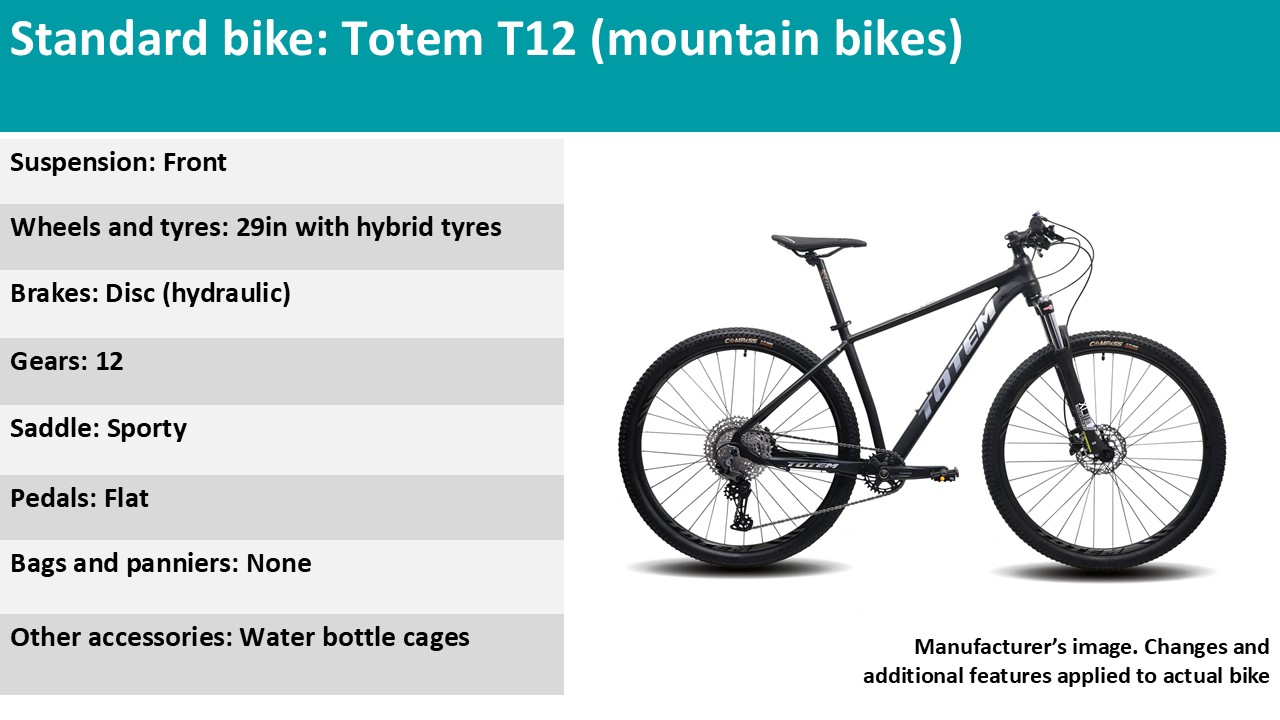
The standard bike for this trip is a Totem T12 mountain bike.
We will take your height at the time of booking to reserve equipment. If you have a preferred bike size, please request when booking.
E-bike upgrade
Electric bikes are available on this trip (subject to availability) for an additional cost. Speak to your sales representative for more information.
Bringing your own bike
If you’d prefer to bring your own bike, please advise us at the time of booking and you will receive a discount on the price of the trip. However, you will be responsible for any extra baggage charges; assembling and disassembling your bike; and bringing along spare parts and any tools specific to it. You should also ensure you have adequate insurance to cover loss, damage or theft.
Accessories and clothing
Bringing equipment from home
You’re welcome to bring your own equipment, such as SPD pedals or clipless pedals, your own saddle (excluding the seat post), or gel saddle cover for the hire bikes. Your leader or guide-mechanic will help you fit these when bikes are distributed.
Helmets
Helmets are mandatory for everyone on a guided Exodus cycling trip. You must bring your own as, following best safety practice, they are not available for hire.
Cycling clothing
For all cycling trips we recommend:
- Padded cycling shorts: For destinations with more modest cultures, we also recommend loose ‘over-shorts’ for riding or rest stops
- Eyewear: Either sunglasses or eye protection with clear lenses to protect the eyes while riding
- Cycling gloves: Especially for riding off-road or on rugged surfaces
- Cycling shoes: Cycling is more efficient with stiff-soled shoes. We don’t recommend open-toed shoes or sandals
- Small close-fitting backpack or bum bag (fanny pack): To keep spare clothing or essential items to hand during the ride
Practical Info & Visa
Passport
Remember to check the expiration date of your passport if travelling internationally. Many countries require your passport to be valid for at least six months after the date of your scheduled return.
Visa
Costa Rica
Travellers from the UK, US and EU normally do not need a visa to enter Costa Rica; however, proof of onward travel may be required – we suggest you take a physical copy of your flight details in case officials ask to see them.
Please note, visa requirements often change and it is your responsibility to obtain any required visas for this trip. Therefore, we recommend that you check with the nearest embassy or consulate of your chosen destination(s), including any countries you may be transiting or transferring through.
Some local governments provide guidance on what visas their citizens need. To help, we’ve gathered a selection of useful links below.
• Australia: www.smartraveller.gov.au/destinations/americas/costa-rica
• Canada: www.travel.gc.ca/destinations/costa-rica
• United Kingdom: www.gov.uk/foreign-travel-advice/costa-rica/entry-requirements
• USA: www.travel.state.gov/content/travel/en/international-travel/International-Travel-Country-Information-Pages/Costa-Rica.html
If you are travelling via the USA and are eligible to transit under the Visa Waiver Program, you are required to register in advance for an ESTA (Electronic System for Travel Authorization). There is a US$40 charge, which is only payable online.
Please note: not all nationalities have the same eligibility for travel to or transit via the USA, and you may not be covered by the Visa Waiver Program. Regulations stipulate that any person who has travelled to Iran, Iraq, Libya, North Korea, Somalia, Sudan, Syria or Yemen since March 2011, or have dual nationalities of these countries, may no longer qualify. In addition, if you have travelled to Cuba since 12 January 2021 you will not be eligible for the visa waiver program and should instead apply for a visa.
If you are in doubt of your eligibility, please check the visa requirements with your local US embassy.
Vaccinations and Health
Costa Rica
There are no required vaccinations. However, you may want to consider vaccinations for tetanus, hepatitis A, rabies and typhoid. The risk of malaria is slight, but you may wish to consult your doctor or travel clinic for further advice.
Many travellers will also require a yellow fever vaccination certificate if arriving from a country with risk of yellow fever transmission, Tanzania and Zambia.
Dengue and zika, both viral diseases spread by mosquitoes, are known risks in Costa Rica. There is currently no vaccine or prophylaxis available, so we strongly recommend you take the usual precautions to avoid mosquito bites.
Please check all requirements and travel vaccination recommendations with your doctor or travel clinic.
Methanol: The FCDO warns travellers to be cautious of methanol poisoning when travelling in destinations visited on the trip.
The Travel Health Pro website recommends to have a rabies vaccination on this trip, as cycling is considered a higher risk activity.
Local Time
Costa Rica's time zone: America/Costa_Rica (UTC -06:00)
Electricity
Costa Rica's electricity:
Plug types A (two flat pins, US standard) and B (three pins, US standard) – 120V, 60Hz

Money
Costa Rica's currency: Costa Rican colon (CRC); however, US dollars are widely accepted
ATM Availability
ATMs are increasingly available in Costa Rica and are now present in most tourist areas. A flat fee of up to US$3 and a small commission usually applies with card withdrawals.
Mastercard and Visa are quite widely accepted in the bigger hotels, restaurants and tourist shops, though not in rural areas. Always check the handling fee when paying by credit card as it can be high.
We recommend you bring some small denomination notes (US$1 and US$5 notes) since getting change is often a problem when paying for small items.
Extra Expenses & Spending Money
For meals not included, snack lunches are approximately 7,800 Costa Rican colones (US$15) and evening meals 12,600-18,900 colones (US$24-US$36) per meal, excluding drinks.
Average costs for drinks are 950 colones (US$1.80) for mineral water or soft drinks, 2,800 colones (US$5.50) for a bottle of beer and 2,400 colones (US$4.50) for a glass of wine.
Tipping
Our local staff are paid fairly for their work. Although tipping is entirely discretionary, it is customary in this part of the world and as such we recommend a per person allowance of 3,700 colones (US$7) per day for your cycling leader plus 2,600 colones (US$5) per day for each driver and the mechanic/assistant leader. The team may ask for a kitty at the start of the trip to cover tipping for hotel porters etc.
Otherwise, porters at the airport and hotels are normally tipped about 500 colones (US$1) per piece.
Tipping is also expected in restaurants – most restaurants will include the 10% tip, as well as the current 13% tax, so expect to see 23% added to your total meal price.
Sustainability and Impact
As a certified B Corp, we’re on a mission to improve our social and environmental impact across all our adventures.
We do this through our innovative Thriving Nature, Thriving People plan.
This ‘nature positive’ approach is designed to help nature and communities thrive in harmony through practical solutions, such as reducing carbon and waste on our trips, supporting conservation projects through the Exodus Adventure Travels Foundation, and rewilding 100 square metres for every Exodus traveller.
On this trip, we:
- Join a local chef to prepare traditional Costa Rican dishes using fresh ingredients grown on-site. Through hands-on cooking and authentic techniques, gain a deeper appreciation for the connection between local food, culture and community livelihoods.
In addition, we support jaguar conservation in Costa Rica through our Foundation’s Jaguar Rewilding Project.
Important Information
Your Safe Participation
When booking this trip, you should be confident in your ability to participate in all activities described in these Trip Notes. If you have any doubt about your suitability, please call us and ask to speak to one of the experts on this itinerary.
Although our leaders are well trained to deal with different capabilities, if they have any concerns about someone’s ability to safely take part in an activity, or their impact on other people’s enjoyment, we authorise them to take necessary action which, in some circumstances, may involve asking someone to miss that activity.
By booking this trip you agree to our Booking Conditions which clearly state that our leaders have the authority to do this. In these rare instances we will ensure anyone sitting out is safely provided for and offered alternative options where possible. Refunds will not be provided for activities missed and customers may be liable for additional costs incurred.
Seatbelts
All vehicles used by us should be equipped with working seatbelts, except where approved by us based on the vehicle type or journey. Wherever seatbelts are available, we require our customers to use them for their own safety, even where it may not be a legal requirement.
Travel Safety
For additional information please have a look at the travel safety advice page on our website.
Optional activities and excursions
If you would like to join an optional activity or excursion outside those listed in the itinerary, your leader may be able to assist with selecting a provider. However, Exodus has not assessed the safety standards of activities or excursions that are not listed in the Trip Notes. All optional activities or excursions are undertaken at your own risk.
How To Book
Speak to our friendly team of experts to plan your adventure:
- Check availability: our website shows real-time availability of our guided group tours, or contact our team by phone, email or live chat.
- Hold a space: You can provisionally hold a space on any guided group tour to give you time to finalise your travel plans.
- Confirm your booking: Payment of a deposit will complete your booking and secure your place on the trip.
After booking
You will receive a confirmation document and invoice, which includes extra information and guidance about your travel arrangements. Our dedicated Customer Operations team will help you with any pre-travel questions or arrangements and can easily add extensions or extra accommodation to your booking. Final Joining Instructions will usually be sent out two to three weeks prior to departure.
Adding transfers to your booking
If you have arranged your own flights and would like to add transfers to your booking, please provide your arrival and departure details to our Customer Operations team around four to six weeks before departure.
- Where complimentary transfers are included, they are available for any flight but can only be added to your booking once we have received your flight schedule.
- Where group arrival and departure transfers are available, these operate at fixed times. You will need to arrive in time to meet the scheduled transfer. If the timings don’t align with your travel plans, our team can arrange private transfers once they receive your flight schedule.
Trip Note validity
Trip notes may be updated after booking; if any updates significantly impact the inclusions or itinerary you will be advised in writing. A link to the most up-to-date Trip Notes will be sent out with your Final Joining Instructions before departure.
The information in these Trip Notes is given in good faith. All holidays can be subject to unexpected changes, and occasionally it may not be possible to follow the itinerary as planned. In these circumstances we will make the best-possible alternative arrangements that maintain the integrity of the original itinerary.
