Current as of: October 8, 2026 - 03:05

Active Nepal: Trails, Rivers & Wildlife Trip Notes
- Ways to Travel: Classic, Guided Group
- Destination: Nepal
- Programmes: Multi-Activity
-
Activity Level:
3 out of 7 - Moderate
- 10 Days: Land Only
- Ages: 16+
- Trip Code: VNA
Trip Overview
Trek beneath the Annapurna range, white-water raft the Seti River and search for rhinos – experience Nepal through active adventure
Get to know Nepal through the activities that bring its landscapes and cultures to life. Walk among Bhaktapur’s temples and try traditional pottery, trek through the Annapurna foothills, then white-water raft the Seti River and camp beside the water. In Chitwan, search for one-horned rhinos by 4×4 and canoe, before meeting members of the Tharu community. Along the way, make momos with Tibetan hosts, practise sunrise yoga in the hills and experience Hindu traditions beside Phewa Lake.
Is This Trip for You?
This trip is rated Activity Level 3 (Moderate). For more information on our trip gradings please visit the Activity Level Guidelines page. If you have any queries about the difficulty of the trip please do not hesitate to contact us.
Suitability: This is a multi-activity adventure, so you should be comfortable taking part in the different activities on offer. The white-water rafting is grade III-IV – prior experience is not needed. For this excursion, you’ll be accompanied by a certified English-speaking guide, with all necessary rafting equipment, including helmets, life jackets and dry bags, provided.
Altitude: Unlike many itineraries in Nepal, the trekking does not go to high altitude. It features low altitude throughout, maximum reached: 5,144ft/1,568m
Adult min age: 16
Min group size: 4
Max group size: 16
Itinerary
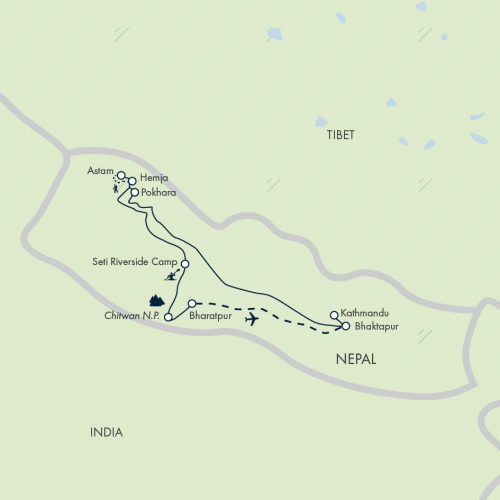
Land Only
- Start City: Bhaktapur
- End City: Kathmandu
Land Only Itinerary
Begin the adventure in Bhaktapur
We start in Bhaktapur, a former royal city known for red-brick squares, Newari craftsmanship and temples dating from the 13th to 18th centuries.
Around 6pm, say namaste to your tour leader and fellow travellers, when we gather as a group for the first time to get to know each other and learn more about the adventures ahead.
Your tour leader then ensures a big Nepali welcome by arranging a group dinner.
Want more time in Kathmandu or Bhaktapur? Secure pre-tour hotel nights through your sales representative.
Accommodation: Hotel Bhadgaon (or similar)
Explore the royal squares of Bhaktapur • Learn pottery skills from local artisans

Early risers can take an optional mountain flight for an aerial introduction to the Himalaya, with the possibility of seeing Everest when conditions are clear.
After breakfast, we regroup to explore Bhaktapur with our tour leader, learning how the city flourished under the Malla kings. Among the palaces, temples and courtyards of its UNESCO-listed historic centre, we see Newari woodcarving, metalwork and brick architecture at close quarters.
Later, local artisans introduce us to one of Bhaktapur’s longstanding crafts during a hands-on pottery session. Working with the same techniques used by generations of potters, we attempt to shape our own piece from clay – with varying degrees of symmetry.
Accommodation: Hotel Bhadgaon (or similar)
Take a scenic drive to Pokhara • Watch the evening aarati beside Phewa Lake

Leaving Bhaktapur, we drive (six to seven hours) west to Pokhara, following the Trishuli River through a landscape of cultivated hills and roadside settlements. Nepal’s road conditions can make journey times unpredictable, so it is worth keeping water and snacks close to hand.
After checking in, we can stretch our legs in the Lakeside district, which runs along the eastern shore of Phewa Lake. As evening falls, we watch the lakeside aarati ceremony, when devotional music, candlelight and ritual create a memorable introduction to Nepal’s Hindu traditions.
Accommodation: Temple Bell Boutique Hotel & Spa (or similar)
Trek through the foothills to Astam • Watch sunset over the Annapurna range
We transfer (20-40 minutes) to the village of Hemja, where we begin our hike into the foothills surrounding Pokhara.
Following our tour leader, we climb through terraced farmland, forest and villages to Astam. The 3mi (5km) ascent takes approximately two to three hours, with 2,028ft (618m) of elevation gain. Trails may be muddy or slippery after rain, so footwear with good grip is required.
Reaching the ridge-top village of Astam at 5,144ft (1,568m), we can look across the Pokhara, Hemja and Mardi valleys towards the Annapurna range when conditions are clear. We then settle into our teahouse lodge, with the chance to watch sunset over the mountains.
Accommodation: Teahouse lodge
Practise yoga beneath the Annapurna range • Make momos with the Tibetan community
Begin with a spirit-boosting yoga session accompanied by views at sunrise over the Annapurna range, waking up our muscles before returning to the trail.
After breakfast, we descend from Astam through forest, terraced fields and villages. The 3mi (5km) walk takes approximately two to three hours, with 2,028ft (618m) of descent. Sections may be slippery after rain, and our tour leader sets a pace suited to the group.
At Hemja, we meet our driver and transfer (20-40 minutes) to Pokhara’s Lakeside district with the afternoon free to relax or explore.
In the evening, we visit a Tibetan settlement for a momo-making class. Our hosts teach us to prepare and fold Nepal’s popular dumplings before we enjoy our creations for dinner and learn more about the community’s food and culture.
Accommodation: Temple Bell Boutique Hotel & Spa (or similar)
Grade III-IV white-water rafting on the Seti River • Camp beside the water

Leave Pokhara and drive (1hr 30min-2hr) to our white-water rafting put-in point. After a safety briefing and paddling instruction from our rafting guides, we take to the Seti River for two to three hours of fun and exhilarating grade III-IV white-water rafting, with plenty of thrills along the way.
The route carries us between forested banks and rural countryside, with stretches of calmer water between the rapids. We finish at our riverside tented camp, where the evening is spent beside the river and around the campfire.
Accommodation: Seti River Camp
Complete the Seti white-water rafting adventure • Meet the Tharu community in Chitwan

Return to the river for the final one to two hours of our white-water rafting adventure, then continue by road to Chitwan (approximately 1hr 30min).
After lunch, we visit a nearby Tharu village with a local guide. Meeting members of the community gives us an introduction to Tharu homes, farming practices and cultural traditions. In the evening, performers demonstrate the coordinated movements and rhythmic clashing of sticks used in a Tharu stick dance.
Accommodation: Green Mansions Jungle Resort (or similar)
Search for rhinos in Chitwan • Canoe along the Rapti River

Spend a full day exploring Chitwan National Park, Nepal’s first national park and a UNESCO World Heritage site. Its forests, grasslands and river systems protect one of the most important populations of greater one-horned rhinos, alongside gharial crocodiles, deer, monkeys and more than 500 recorded bird species.
Accompanied by specialist nature guides, we search for wildlife on a 4×4 safari and take a canoe ride along the Rapti River. A guided jungle walk provides a closer look at the park’s plants, tracks and smaller wildlife, with our guide interpreting signs we might otherwise pass unnoticed.
Accommodation: Green Mansions Jungle Resort (or similar)
Fly across Nepal to Kathmandu • Enjoy a free afternoon in the capital
Early risers can join a birdwatching excursion with a nature guide before breakfast.
We later transfer (approximately 30 minutes) to Bharatpur Airport and fly to Kathmandu. When the weather is clear, the short flight provides another opportunity to see Nepal’s hills and distant mountains from above.
After transferring to the hotel, the remainder of the day is free. Our tour leader can recommend places to visit, shop or eat according to your interests.
Accommodation: Royal Singi Hotel (or similar)
End the adventure in Kathmandu
You’ve shaped clay with Bhaktapur’s potters, trekked beneath the Annapurna range and rafted the Seti River, but now it’s time to begin your return journey home.
Alternatively, if you’d like to extend your adventure, speak to your sales representative to discuss our large range of extension options.
Accommodation
Hotels, teahouse and riverside camp

We aim to secure locally owned accommodation that is well located, offers good value for money, and plenty of comfort.
Seti River: Seti River Camp (night 6)
Enjoy the serenity of the wild with a night camping by the Seti River. Evenings are spent relaxing in our remote spot, gathering around the campfire as we share stories and listen to nature. The site itself has 16 twin-bed tents on raised platforms, each shaded by a thatch or slate roof. Each also has a private bathroom with hot water. There’s also a main dining area, where we tuck into food prepared by the on-site chef.
Chitwan: Green Mansions Jungle Resort (nights 7-8)
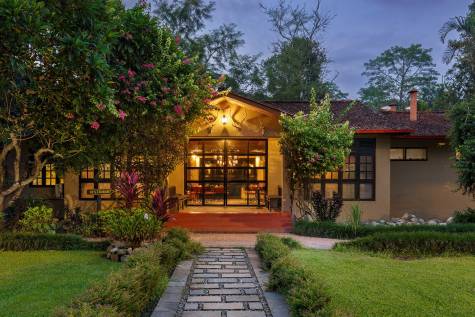
On the edge of a community forest, Green Mansions offers traditional cottages encompassed by nature. The highlight may well be the in-house team of naturalists, who bring the landscape to life with their expertise. Other pluses include a pool with half-sunken loungers and a multi-cuisine restaurant where dishes include produce from the hotel garden.
Worth knowing
- Tailor your trip: Extend your adventure by securing extra hotel nights before or after the main itinerary. Speak to your sales representative to book.
- Private rooms: Like most tour operators, we room solo passengers together. If you’d prefer to have a private room, it’s normally possible to do this for a supplement. Speak to your sales representative to book.
- River camp: In this remote spot, only accessible by boat, there is no electricity, but kerosene lamps, torches and candles are provided.
Food & Drink
Allow approximately 3,000-5,000 rupees (US$22-US$38) per day for meals not included in Kathmandu and Pokhara.
Dhal bhat is the staple diet in Nepal and comes in many different forms but generally comprises curried lentil dhal and meat or vegetables, rice, and a pickle/chutney. Another popular snack is momos, a Nepalese dumpling filled with meat or vegetables.
If you have a gluten-free diet, we strongly recommend you bring extra food and snacks with you to supplement the food on trek as there will be little variety available to you, particularly for breakfast. Even some soups are from powder/packets and contain gluten.
Weather & Seasonality
The primary season for active adventures in Nepal is from October to mid-May when daytime temperatures at most altitudes are generally comfortable for walking, the sky is clear much of the time, and rain and snow are occasional occurrences. Daytime temperatures vary from 15C to 30C (59F to 86F).
However, different seasons offer different advantages for active adventures.
Mid-September to November: Daytime temperatures are up to 25C (77F). Skies are usually clear and days are sunny and mild with clear mountain views. Nights are colder with temperatures dropping to about 5C (41F).
December to end of February: Despite the cooler conditions, this is an ideal time for active adventures in Nepal. In December, the skies are usually very clear, the days are sunny, and the mountain views are at their best. Early mornings and evenings are cold with temperatures down to about 5C (41F), but days are sunny with temperatures up to 22C (72F). The trails are also much less busy. Chitwan is cold in the early mornings and evenings but pleasantly warm in the daytime.
March to May: Temperatures are warmer in general, but haze often builds in the afternoons and there can be rain. Temperatures rise to 30C (86F) and above in Chitwan and in Kathmandu. The days are hotter (up to 25C/77F) and nights are a bit cooler. Flowers bloom in this season and this is one of the reasons people chose to visit at this time.
In any mountainous area, the weather is never wholly predictable; you should be prepared and equipped to deal with any differences in weather beyond the conditions described above.
Joining Instructions
Key information
Start hotel: Hotel Bhadgaon, Barahisthan, Bhaktapur 44800
Phone: +977 1-6620038
Recommended arrival time: You can arrive at any time on Day 1. There will be a welcome briefing around 6pm
Airport: Tribhuvan International Airport (KTM)
Getting to the start hotel
The start hotel is approximately 45 minutes’ drive from the airport. We provide free arrival transfers to the start hotel from the airport for everyone. If you would like further information on joining this trip, please speak to your sales representative.
Catching your return flight
We provide free departure transfers for everyone to Tribhuvan International Airport from the end hotel.
Please note, unless specified otherwise, the transfers will be to the start (or pre-tour) hotel and from the end (or post-tour) hotel and will be on the date on which the tour starts/ends; transfers to other hotels in the same city and/or on different dates may attract an extra charge. Transfers should be booked with your sales representative at least two weeks before the tour starts.
Full joining instructions including local emergency numbers will be sent to you as part of our Final Joining Instructions. If you do not receive these at least a week before departure, or require them earlier please contact our office or your travel agent.
Location start: Bhaktapur
Location end: Kathmandu
What To Take
Practical Info & Visa
Visa
Nepal
You can obtain your visa in advance or on arrival. The Immigration Department of Nepal has suspended visas on arrival for certain nationalities – please check if this applies to you with your nearest embassy or consulate.
Visa in advance
To get a visa in advance you can apply online at nepaliport.immigration.gov.np and collect it from your nearest Nepali embassy. Find more information at https://immigration.gov.np/
Visa on arrival
- When you arrive at Tribhuvan International Airport in Kathmandu, there will be three lines. If you have already secured your visa, go straight to the Immigration line. If not:
Fill in a tourist visa form at the electronic kiosks. After inserting your passport, the machine will automatically fill out an application form, take an electronic photograph of you and print a paper slip. If the machine won’t read your passport, complete the details manually using the touchscreen. We recommend taking a passport photo with you just in case.
Top tip: This process can be completed through the online immigration portal (click ‘Visa On-Arrival’) within 14-days prior to arrival in Kathmandu, helping you to avoid lengthy queues at the kiosks when you come through immigration – ensure you print and bring the confirmation with you. If you have completed your visa on arrival form in advance, go directly to the visa fees counters with your printed confirmation and skip the kiosk queues. - Proceed to the visa fees collection counter and pay the visa fee (in cash, if possible). Make sure to keep the receipt. Card payments are not always possible, so paying in cash is easiest, most currencies are accepted but US dollars are preferred.
- Go to the relevant immigration desk and present your tourist visa form, payment receipt and passport to obtain your 15-, 30- or 90-day visa stamp. Please check you have been given the correct visa duration.
Vaccinations and Health
There are no required vaccinations. However, recommended vaccinations include tetanus, typhoid, hepatitis A, hepatitis B, cholera, Japanese encephalitis, rabies and tuberculosis. You will also need a yellow fever vaccination certificate if you’re arriving from a country with risk of yellow fever transmission or transiting for more than 12 hours through a country with risk of yellow fever transmission. Some travellers may also need proof of a polio vaccination. Please confirm with your doctor or travel clinic.
There is little to no risk of malaria in Nepal; therefore, antimalarial tablets are not usually advised although may be considered for certain high-risk groups. You may wish to consult your doctor or travel clinic for further advice.
Additionally, dengue fever and chikungunya are known risks in Nepal. Both are tropical viral diseases spread by daytime biting mosquitoes. There is currently no vaccine or prophylaxis available for either, and therefore the best form of prevention is to avoid being bitten. We recommend you take the usual precautions to avoid mosquito bites.
Local Time
Nepal's time zone: Asia/Kathmandu (UTC +05:45)
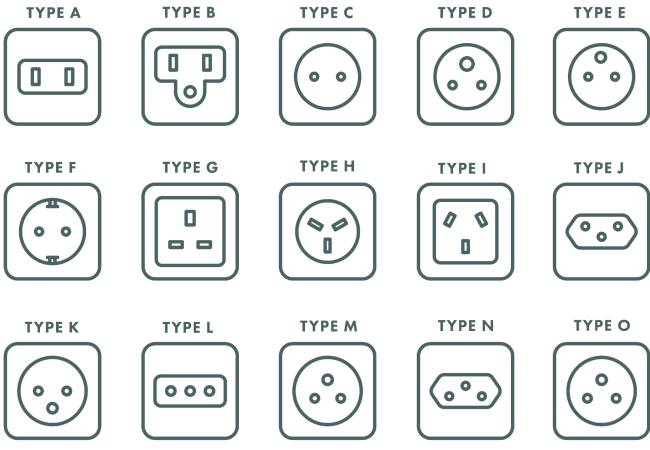
Electricity
Nepal's electricity:
Plug types C (two round pins, European standard), D (three round pins) and M (three round pins) – 230V, 50Hz
Mains electric ‘load shedding’ (planned temporary power cuts) occur regularly throughout towns and cities in Nepal. On teahouse treks, the majority of lodges now have electricity and charging facilities in the communal areas for batteries, for a fee. Battery life can be affected by cold; lithium batteries are best.
Money
Nepal's currency: Nepalese rupee (NPR) It is illegal to import or export rupees, but foreign currency is not limited, provided it is declared on arrival. Keep your change receipts, as you will need them if you want to change rupees back into hard currency at Kathmandu airport.
Sustainability and Impact
As a certified B Corp, we’re on a mission to improve our social and environmental impact across all our adventures.
We do this through our innovative Thriving Nature, Thriving People plan.
This ‘nature positive’ approach is designed to help nature and communities thrive in harmony through practical solutions, such as reducing carbon and waste on our trips, supporting conservation projects through the Exodus Adventure Travels Foundation, and rewilding 100 square metres for every Exodus traveller.
Important Information
Your Safe Participation
When booking this trip, you should be confident in your ability to participate in all activities described in these Trip Notes. If you have any doubt about your suitability, please call us and ask to speak to one of the experts on this itinerary.
Although our leaders are well trained to deal with different capabilities, if they have any concerns about someone’s ability to safely take part in an activity, or their impact on other people’s enjoyment, we authorise them to take necessary action which, in some circumstances, may involve asking someone to miss that activity.
By booking this trip you agree to our Booking Conditions which clearly state that our leaders have the authority to do this. In these rare instances we will ensure anyone sitting out is safely provided for and offered alternative options where possible. Refunds will not be provided for activities missed and customers may be liable for additional costs incurred.
Seatbelts
All vehicles used by us should be equipped with working seatbelts, except where approved by us based on the vehicle type or journey. Wherever seatbelts are available, we require our customers to use them for their own safety, even where it may not be a legal requirement.
Travel Safety
For additional information please have a look at the travel safety advice page on our website.
How To Book
Speak to our friendly team of experts to plan your adventure:
- Check availability: our website shows real-time availability of our guided group tours, or contact our team by phone, email or live chat.
- Hold a space: You can provisionally hold a space on any guided group tour to give you time to finalise your travel plans.
- Confirm your booking: Payment of a deposit will complete your booking and secure your place on the trip.
After booking
You will receive a confirmation document and invoice, which includes extra information and guidance about your travel arrangements. Our dedicated Customer Operations team will help you with any pre-travel questions or arrangements and can easily add extensions or extra accommodation to your booking. Final Joining Instructions will usually be sent out two to three weeks prior to departure.
Adding transfers to your booking
If you have arranged your own flights and would like to add transfers to your booking, please provide your arrival and departure details to our Customer Operations team around four to six weeks before departure.
- Where complimentary transfers are included, they are available for any flight but can only be added to your booking once we have received your flight schedule.
- Where group arrival and departure transfers are available, these operate at fixed times. You will need to arrive in time to meet the scheduled transfer. If the timings don’t align with your travel plans, our team can arrange private transfers once they receive your flight schedule.
Trip Note validity
Trip notes may be updated after booking; if any updates significantly impact the inclusions or itinerary you will be advised in writing. A link to the most up-to-date Trip Notes will be sent out with your Final Joining Instructions before departure.
The information in these Trip Notes is given in good faith. All holidays can be subject to unexpected changes, and occasionally it may not be possible to follow the itinerary as planned. In these circumstances we will make the best-possible alternative arrangements that maintain the integrity of the original itinerary.
