5 Best Places to Visit in South Korea: Seoul, Busan & Beyond
South Korea packs a lot into a relatively small corner of East Asia. One day you could be exploring Seoul’s royal palaces and neon-lit neighbourhoods; the next, walking beneath the granite peaks of Seoraksan National Park or tracing almost 1,000 years of Silla history in Gyeongju.
Ancient Buddhist temples sit surprisingly close to high-tech cities, while mountains and coastline are never too far away.
So, where should you start? On our Discover South Korea trip, we explore the country with expert local guides, getting beneath the history, culture and landscapes that have shaped it.
Here are five of the best places to visit in South Korea – and what makes each worth your time.
1. Seoul: Palaces, markets and centuries of history

Skyscrapers, centuries-old palaces, Buddhist temples and some seriously good street food all compete for your attention in Seoul. On our Discover South Korea trip, you’ll spend two days getting to know the capital with an expert local guide, uncovering the history and traditions behind this fast-moving city.
Food is a good place to start. Gwangjang Market is one of South Korea’s largest food markets, packed with stalls serving local specialities like Dak-kkochi, Eomuk and Bungeo-ppang.
Elsewhere, the 11km-long urban oasis, Cheonggyecheon Stream, cuts a surprisingly peaceful path through central Seoul. Your group will also visit Tapgol Park, the birthplace of Korea’s March 1st Independence Movement in 1919, with monuments commemorating those who resisted Japanese colonial rule.
Seoul’s more traditional side comes into focus in Insadong, a cultural district of teahouses, antique shops and galleries, and at colourful Jogyesa Temple, the centre of Korean Zen Buddhism.
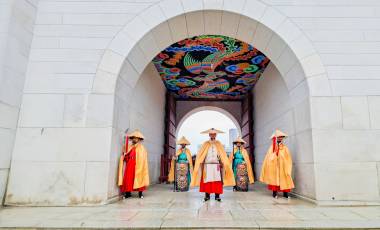
But perhaps nowhere captures the city’s past quite like Gyeongbokgung Palace. Beyond the imposing Gwanghwamun Gate, you can explore the former royal complex, including its Throne Hall, Gyeonghoeru Pavilion and museums dedicated to Korea’s royal and folk history.
And tucked among the modern city is Bukchon Hanok Village, where narrow lanes are lined with traditional Joseon-era-style houses, now interspersed with art studios, museums and cafés. It’s this closeness of old and new that makes Seoul such an intriguing place to explore.
View the trip

Discover South Korea
Explore the Land of the Morning Calm
2. The DMZ: Understanding Korea’s divided history

Around 30 miles north of Seoul lies one of the most heavily guarded borders in the world.
The Korean Demilitarised Zone (DMZ) has separated North and South Korea since 1953, when an armistice brought three years of fighting in the Korean War to an end.
Stretching roughly 150 miles across the Korean Peninsula, the DMZ forms a buffer around the Military Demarcation Line separating North and South. On our Discover South Korea trip, a JSA (Joint Security Area)-specialised local guide provides insight into the Korean War, the division of the peninsula and the tensions that have shaped relations between the two countries ever since.
One of the most fascinating stops is the Third Infiltration Tunnel. Discovered in 1978, the 1.6km-long tunnel was dug beneath the border by North Korea and is one of four infiltration tunnels discovered to date.
You’ll also visit observation points overlooking the border area, putting the scale – and continuing reality – of Korea’s division into perspective.
3. Gyeongju: The museum without walls

Another standout stop on our South Korea trip is Gyeongju, the ancient capital of the Silla Kingdom (57 BC–935 AD). Commonly described as ‘the museum without walls,’, it’s one of the country’s most historically rich cities, filled with royal tombs, vibrant Buddhist temples and UNESCO World Heritage sites.
With your expert local guide, you’ll explore Daereungwon Tumuli Park, where huge grass-covered burial mounds mark the resting places of Silla royalty. Nearby stands Cheomseongdae, built in the seventh century and considered the oldest surviving astronomical observatory in Asia – a remarkable reminder of the scientific advances made during the Silla period.
Some of Gyeongju’s most impressive Buddhist heritage lies just outside the city. Carved into the slopes of Tohamsan Mountain, the eighth-century Seokguram Grotto houses a monumental stone Buddha seated in the lotus position, surrounded by guardians, deities and bodhisattvas. At nearby Bulguksa Temple, look out for the main Daeungjeon Hall and the contrasting stone pagodas of Seokgatap and Dabotap.
There’s more Silla history at Anapji Pond, once part of the royal palace complex. Excavations here unearthed thousands of artefacts from the period, including gold crowns, a royal barge, scissors and more, some of which can now be seen at Gyeongju National Museum alongside the city’s extraordinary collection of Silla treasures.
4. Seoraksan National Park: Mountain trails and ancient temples

Beyond South Korea’s fast-paced cities and ancient temples, you’ll find some seriously impressive mountain country. Seoraksan National Park, near the east coast, is one of the country’s best-known mountain landscapes, with jagged granite peaks, forested valleys and waterfalls threaded by walking trails.
On our Discover South Korea trip, you can explore on foot, with trails ranging from around 2km to 10km. Your tour leader guides an easy, shorter walk from the foot of the mountains, where you’ll also see the enormous bronze Buddha beside Sinheungsa Temple. The temple itself has much deeper roots: it traces its history back to the Silla period and was originally founded in AD 652.
If you’d rather gain some height without the legwork, take the optional cable car towards Gwongeumseong Fortress for far-reaching views across Seoraksan’s rocky peaks and valleys. Either way, it’s a chance to see the wilder side of South Korea – and why these mountains have become one of the country’s most celebrated natural landscapes.
5. Busan: Seafood markets & coastlines

South Korea’s second-largest city has a different rhythm to Seoul. Set between mountains and the sea, Busan is known for its coastline, busy markets and seafood scene – with plenty of history woven in too.
On our Discover South Korea trip, your expert local guide will introduce you to some of the city’s key sights, including Gwangalli Bridge and the UN Memorial Cemetery, the final resting place of United Nations soldiers who died during the Korean War (1950–1953). You’ll also visit Nurimaru APEC House, where world leaders gathered for the 2005 APEC summit, in a striking spot overlooking the ocean.
For a taste of everyday Busan, head to Jagalchi Fish Market, one of Korea’s largest seafood markets. Stalls are piled with everything from octopus and squid to sea urchins and sea cucumbers.
If you’re feeling adventurous, you can pick from the fish on offer, and the vendors will prepare it for you on the spot. The market is known for its Korean-style sashimi, often accompanied by gochujang and lettuce wraps.
Next door, Gukje Market has a very different story. It grew in the years around the Korean War, as refugees who had fled to Busan set up stalls to make a living, and today its maze of shops sells clothing, crafts, souvenirs and street food.
If you still have some energy left after dinner, take the optional trip up 118m-high Busan Tower situated in Yongdusan Park. From the observation deck, you’ll be able to see the illuminated lights of the Busan Port, the Gwangalli Bridge, the city’s towering skyscrapers and the silhouette of the surrounding mountains and coastline.
Frequently Asked Questions
For a first trip to South Korea, Seoul, Gyeongju, Seoraksan National Park and Busan are excellent places to start. Together, they offer a mix of royal palaces and food markets, ancient Silla history, mountain landscapes and coastal city life. From Seoul, you can also visit the DMZ to learn more about the division of the Korean Peninsula.
Around ten days to two weeks is ideal for a first trip to South Korea if you want to explore beyond Seoul. This gives you time to experience the capital alongside destinations such as Seoraksan National Park, Gyeongju and Busan, without rushing between them.
Spring and autumn are generally considered the best times to visit South Korea. Spring brings milder temperatures and blossom, while autumn typically offers comfortable walking conditions and vibrant foliage, particularly in mountain areas such as Seoraksan National Park.
Yes, South Korea is an excellent destination for hiking, with mountains and national parks within easy reach of many cities. Seoraksan National Park is one of the country’s best-known hiking destinations, with trails through forested valleys and beneath dramatic granite peaks, including options suitable for more leisurely walkers.
Yes, you can visit the Korean Demilitarised Zone (DMZ) from Seoul on an organised tour, subject to current access restrictions. Around 30 miles north of the capital, the DMZ offers an insight into the Korean War and the continuing division between North and South Korea. Our Discover South Korea trip visits the DMZ with a JSA-specialised local guide.